Posts

Showing posts with the label cwdm

WDM Transmission Solution

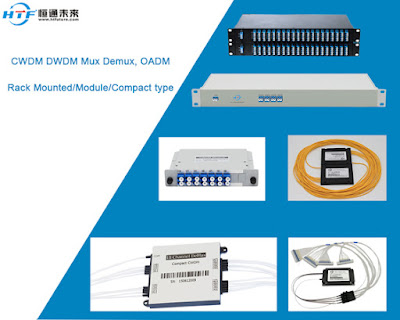
Image
There are CWDM/DWDM/LWDM always in optical communication industry, Wavelength Division Multiplexing ( WDM ) is a fiber-optic transmission technique that enables the use of multiple light wavelengths (or colors) to send data over the same medium. Two or more wavelengths can travel on one fiber, and several signals can be transmitted in an optical waveguide at differing wavelengths or frequencies on the optical spectrum. Advances in optoelectronic components allowed the design of systems that simultaneously transmitted multiple wavelengths of light over a single fiber, significantly increasing fiber capacity. Then, WDM transmission was applied. Multiple high rate data streams of 10 Gb/s, 40 Gb/s, 100 Gb/s, 200 Gb/s and more recently, 400 Gb/s and 800 Gb/s, each carrying distinct throughputs, can be multiplexed over a single fiber. There are three types of WDM defined by ITU-T: Coarse WDM (CWDM): CWDM is defined by WDM systems with fewer than 18 active wavelengths per fiber, from 1270nm t...

How to wire CCWDM multiplexer?

Image
A three-port filter for a specific wavelength of CWDM whose wavelength channel consists of two lenses and a TFF matched to that specific wavelength. The reflection port of each filter is connected to the common port of the next filter, and the filters are connected through optical fiber connectors, which is a CWDM multiplexer . The principle of CCWDM is to use the input lens to focus the optical signals with wavelengths λ 1, λ 2... λ n on the input fiber onto the first filter; the optical signal with wavelength λ 1 passes through the first filter and is coupled to the optical fiber via the first output lens. In the first output fiber, the optical signal with wavelength λ 1 is separated; the remaining optical signals are reflected from the first glass slide to the next glass slide for optical signal separation; and so on until all signals are separated. The coupling between wavelength channels is realized in the form of straight rays taking a zigzag route. HTF has achieved mass producti...

DWDM Application

Image
Due to the need for network operators to transmit a large amount of data and communication traffic between different cities, regions, and even countries, equipment capable of achieving long-distance transmission is required. The long-distance transmission capability of DWDM technology allows operators to conduct data transmission over ultra-long distances. DWDM technology can transmit several dozen or even hundreds of wavelengths over a single optical fiber, enabling operators to simultaneously engage in various services, including data, voice, and video. By enhancing the efficiency of network resource utilization, DWDM technology possesses significant scalability and upgradeability. With the continuous development of communication technology, the number of channels in DWDM will continue to increase. DWDM technology can also be applied to connect various data centers. Data centers play an increasingly important role in internet services, and Data Center Interconnect (DCI) is a critica...

What are the Benefits of DWDM Networks

Image
By deploying a DWDM network, you will gain the following benefits: High Bandwidth and Capacity : DWDM technology achieves higher bandwidth and capacity by multiplexing multiple wavelengths of signals on a single optical fiber compared to conventional devices. In the backdrop of the ever-growing demands of the internet and communication, the high capacity becomes especially critical, especially in domains like high-definition video, cloud computing, and the Internet of Things. Long-Distance Transmission : DWDM technology employs wavelengths with minimal signal loss in the optical fiber transmission process. When paired with Transponders/EDFAs, it can even transmit signals over thousands of kilometers. This attribute is especially important for connecting remote cities, spanning international borders, and linking data centers across continents. The extensive long-distance transmission capability of DWDM greatly extends the reach of data communication, effectively facilitating seamless ...

Difference Between CWDM and DWDM

Image
Wavelength division multiplexing (WDM), including CWDM (coarse wavelength division multiplexing) and DWDM (dense wavelength division multiplexing), etc. It refers to the coupling of multiple signals of different wavelengths on a single fiber for simultaneous transmission. It has multiplexer and de-multiplexer. The multiplexer (MUX) combines multiple signal wavelengths in a single fiber for transmission at the transmitter side; the de-multiplexer (DEMUX) separates multiple wavelength signals transmitted in a single fiber at the receiver side. The main purpose of WDM is to increase the available bandwidth of the fiber, which can be expanded by WDM without the need to lay more fibers. What is the difference between CWDM and DWDM? 1.  Different wavelength intervals CWDM: wavelength interval ≥20nm, total 18 bands  of 1 2 70 nm ~1610nm with 20nm interval, DWDM: wavelength interval <10nm, usually using 1528nm~1565nm band with wavelength interval of 200GHz (1.6nm), 100GHz (0.8nm) ...

Wavelengths in different bands

Image
  With the rapid development of 5G networks, the demand for network data transmission is increasing exponentially. As the underlying bearer network, the transmission capacity of optical networks is crucial to the development of 5G networks. One of the magic weapons to expand the transmission capacity of optical networks is to continuously dig deep into the available band resources of optical fibers, that is, to continuously expand the transmission path width of optical networks. The wider the transmission road, the transmission capacity of the optical network will naturally increase. Next, I will talk to you about these bands of optical fiber.   T raditional band As the name implies, optical fiber communication is the communication in which light is used as an information carrier and optical fiber is used as a transmission medium. However, not all light is suitable for fiber optic communication. Different wavelengths of light (which can be simply understood as light with diffe...

Do you know the difference between 40G QSFP+ CWDM and PSM?

Image
QSFP 40G LR4 optical module is widely used in 40G network, it includes two types of QSFP 40G LR4 CWDM optical module and QSFP 40G LR4 PSM optical module. What are CWDM and PSM? CWDM (Coarse Wavelength Division Multiplexing) refers to coarse wavelength division multiplexing. CWDM is a kind of WDM (wavelength division multiplexing). It can send and receive signals on multiple channels on a single optical fiber. It is usually used in communication networks. point-to-point structured wiring. PSM (Parallel Single Mode Fiber) refers to parallel single-mode fiber technology. Unlike CWDM optical modules that transmit or receive signals on multiple channels on a single fiber, PSM can simultaneously receive and send signals on four parallel fibers. Overview of QSFP 40G LR4 CWDM Optical Transceiver QSFP 40G LR4 CWDM module usually refers to QSFP+ 40G LR4 optical module, which has LC duplex interface, four independent transceiver channels, and each channel supports a rate of 10Gbps. In order to m...

What is CWDM multiplexer

Image
CWDM (Coarse Wavelength Division Multiplexing) is a technique for combining multiple optical signals on a single fiber by using different wavelengths of light. CWDM technology is widely used in modern communication networks, and it enables significant cost savings while improving network capacity and flexibility. CWDM multiplexers are at the core of this technology, allowing multiple data streams to be combined and transmitted over a single optical fiber. What is a CWDM Multiplexer? A CWDM multiplexer is an optical device that combines multiple wavelengths of light into a single optical signal. It uses the principle of combining different wavelengths of light into one fiber to transmit signals from multiple sources. Each wavelength is modulated with a unique data stream, and the CWDM multiplexer combines these signals into a single fiber. The signal is then transmitted to the receiver where it is de-multiplexed back to its original form. Advantages of CWDM Multiplexer The benefits of ...

What is the difference between CWDM, DWDM and CCWDM

Image
Wavelength division multiplexing (WDM), including CWDM (coarse wavelength division multiplexing) and DWDM (dense wavelength division multiplexing), etc. It refers to the coupling of multiple signals of different wavelengths on a single fiber for simultaneous transmission.   It has multiplexer and de-multiplexer. The multiplexer (MUX) combines multiple signal wavelengths in a single fiber for transmission at the transmitter side; the de-multiplexer (DEMUX) separates multiple wavelength signals transmitted in a single fiber at the receiver side. The main purpose of WDM is to increase the available bandwidth of the fiber, which can be expanded by WDM without the need to lay more fibers. What is the difference between CWDM and DWDM?   - Different wavelength intervals CWDM: wavelength interval ≥20nm, usually using eight bands of 1470~1610nm with 20nm interval, (HTF: 1270nm~1610nm) DWDM: wavelength interval <10nm, usually using 1550~1570nm band with wavelength interval of 200GHz...